


[Day 2] Trainee Research Presentation: New Perspectives on Menstrual Health
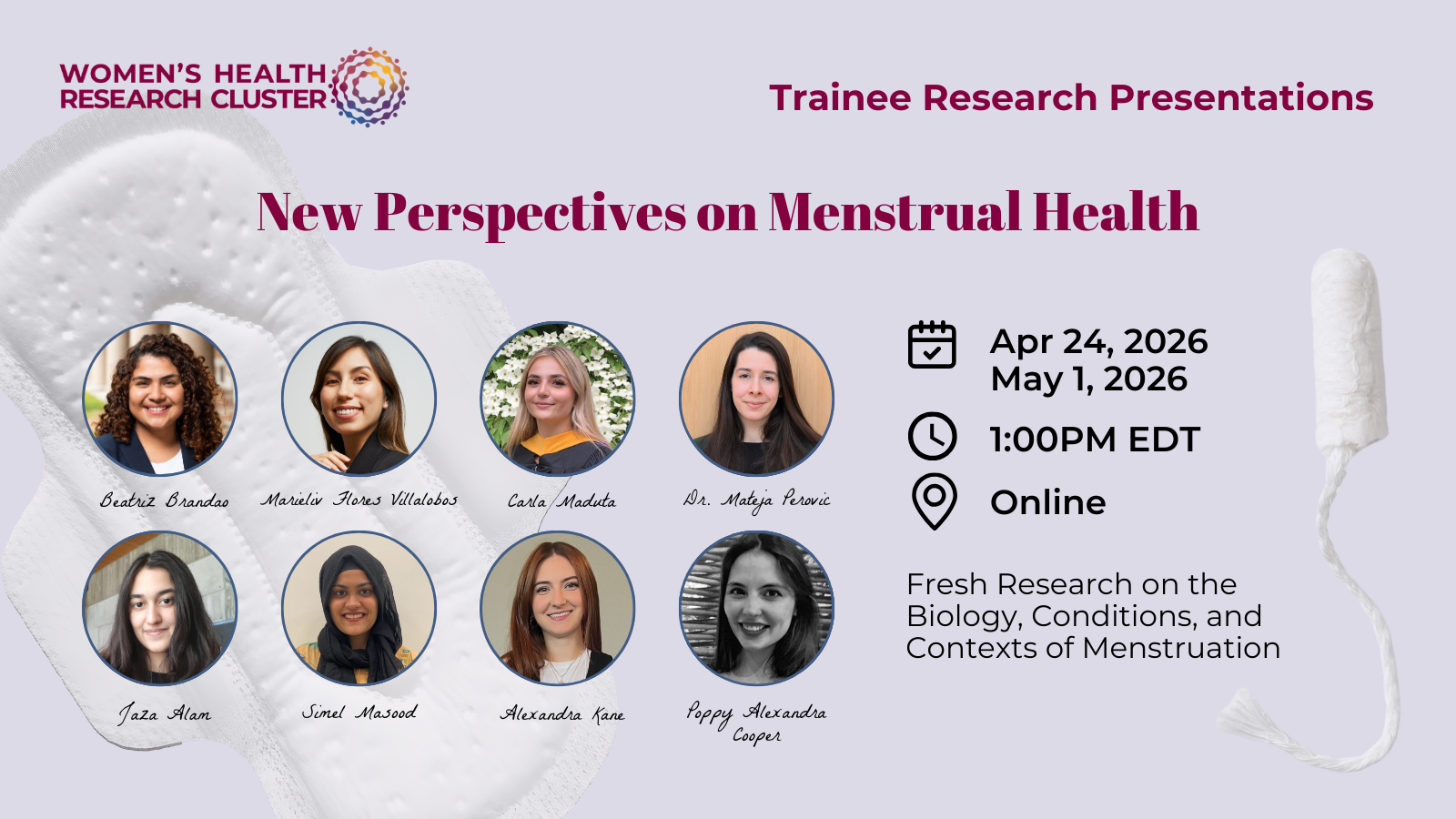
Fresh Research on the Biology, Conditions, and Contexts of Menstruation
New Perspectives on Menstrual Health brings together emerging researchers exploring the biology, conditions, and social contexts of menstruation. Across two virtual sessions on April 24 and May 1, eight trainee scientists will present their latest research on topics ranging from menstrual health conditions to menstrual hygiene and everything in between. Each short presentation will be followed by time for audience questions and discussion, offering a chance to engage directly with the next generation of menstrual health researchers.
Day 2 Agenda
Investigating unconventional T cells as superantigen targets in menstrual toxic shock syndrome
Carla Maduta
1:00PM – 1:15PM
Menstrual toxic shock syndrome (mTSS) is a life-threatening disease caused by the bacterium Staphylococcus aureus. S. aureus can make dozens of toxins called ‘superantigens’ which hijack our immune system by targeting white blood cells called T cells. Interestingly, only one superantigen can cause mTSS, but the reason why is unknown. In our work, we use blood from healthy donors to isolate T cells and measure their ability to become activated. We have identified an unconventional T cell population which is more sensitive to the mTSS superantigen than typical T cells, which we hypothesize allows for the establishment of mTSS.
Genetic Risk Pathways in Endometriosis and Early Diagnostic Potential
Jaza Alam
1:15-1:30PM
Endometriosis is a common condition that causes painful periods and often goes undiagnosed for years. Many individuals experience significant symptoms before receiving answers. My research examines whether specific genetic patterns linked to inflammation, hormone metabolism, and immune regulation are more common in those at risk for endometriosis. By identifying how these pathways interact, we hope to better understand why symptoms develop and persist. In the long term, this work may support earlier, non-invasive diagnosis and more personalized approaches to menstrual health care.
Exploring Menstrual Hygiene Management in Acute Humanitarian Settings: A Multi-Methods Study
Alexandra Kane
1:30-1:45PM
According to the United Nations High Commissioner for Refugees (UNHCR), more than 122 million people worldwide are displaced due to conflict, political instability, or environmental disasters, about half of which are women and girls of menstruating age. At the onset of emergencies, international humanitarian aid efforts often focus on life-saving needs like food, shelter, and medicine, while menstrual hygiene management (MHM) is often overlooked. Without proper menstrual products or facilities, women may face physical and mental health impacts (e.g., infections, social isolation). This study will review existing research and policy through a scoping review and then interview key informants to understand how MHM is defined, examine initiatives, and identify ways to improve menstrual hygiene support during acute humanitarian emergencies.
From Menstrual Irregularity to Molecular Risk: Blood-Based Biomarker Patterns Linking PCOS to Reproductive Cancer
Simel Masood
1:45PM – 2:00PM
Polycystic ovary syndrome (PCOS) is a common hormonal condition and a major cause of irregular periods and ovulation problems. PCOS has also been linked to oxidative stress and a higher risk of some gynecologic cancers, but the biological connections are not well understood. We collected blood samples in Lahore from healthy controls, women with PCOS, and patients with ovarian, cervical, or endometrial cancer. Using RT-qPCR, we measured activity of genes involved in hormones, oxidative stress, and tumor suppression. Cancer samples showed clear reductions in protective pathways, especially PTEN and NFE2, while PCOS samples were more stable. These blood-based patterns may support future screening and prevention research.


