


[Day 1] Trainee Research Presentation: New Perspectives on Menstrual Health
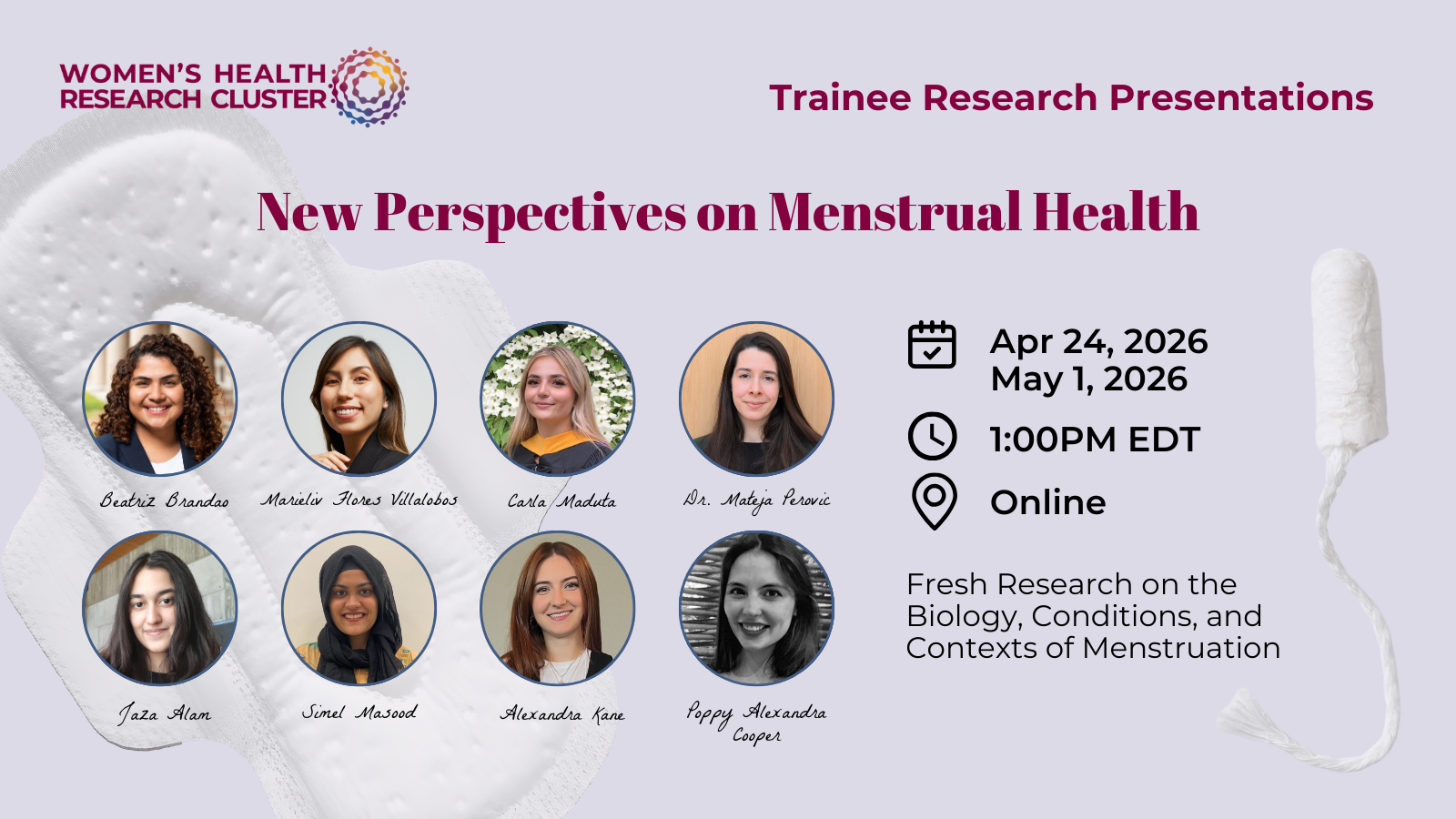
Fresh Research on the Biology, Conditions, and Contexts of Menstruation
New Perspectives on Menstrual Health brings together emerging researchers exploring the biology, conditions, and social contexts of menstruation. Across two virtual sessions on April 24 and May 1, eight trainee scientists will present their latest research on topics ranging from menstrual health conditions to menstrual hygiene and everything in between. Each short presentation will be followed by time for audience questions and discussion, offering a chance to engage directly with the next generation of menstrual health researchers.
Day 1 Agenda
The Flow in Times of COVID: understanding explanatory models and women’s perceptions of their period
Marieliv Flores Villalobos
1:00PM – 1:15PM
What is the meaning of your menstrual cycle? What does your period tell you about your health? Do academia and the health system have the answer to those questions? As women, we live in a society that has specific instructions on what we should do when we bleed; however, there are few opportunities to explore our personal understanding of the menstrual cycle in our daily lives. This presentation highlights women’s menstrual cycle experiences before and within the context of the COVID-19 pandemic to explore if external factors impact women’s perspectives of their period.
Behavioural and neural dynamics of complex cognition across the menstrual cycle
Dr. Mateja Perovic
1:15PM – 1:30PM
This talk will examine cognitive effects of the menstrual cycle using concept formation – a core cognitive process that requires coordination of learning, memory and attention, as a model of complex cognition. The talk will combine behavioural, imaging and genetic data to provide a comprehensive neurobiological account of concept formation across the menstrual cycle, and explore new methodological directions for studying cognition across the menstrual cycle.
Menstrual cycle phase and its association with COVID-19 vaccine outcomes: A study of period tracking app users
Poppy Alexandra Cooper
1:30PM – 1:45PM
Men and women have different immune responses to vaccines. Women generally experience more side effects, but also gain more protection against the disease. A big part of the reason why is reproductive hormones: estrogen can strengthen the immune response, while progesterone and testosterone can dampen it. Because a woman’s hormones change throughout the menstrual cycle, this study explored whether the timing of a COVID-19 vaccine—depending on which phase of her cycle she was in—affected her side effects and her risk of infection.
Emotion Regulation Across the Menstrual Cycle: Implications for Women’s Mental Health
Beatriz Brandao
1:45PM – 2:00PM
Emotional changes across the menstrual cycle are commonly reported, yet the menstrual cycle remains understudied in mental health research. This study examines how hormonal fluctuations across the menstrual cycle influence emotional responses and the effectiveness of emotion regulation strategies. Participants complete laboratory tasks that measure emotional reactivity and emotion regulation while menstrual cycle phase is tracked. Understanding how hormonal changes shape emotion regulation may help mitigate the negative symptoms that many women experience premenstrually and inform more tailored interventions for conditions such as premenstrual syndrome (PMS) and premenstrual dysphoric disorder (PMDD).


