Tag Archive for: menopause

Menopause Series Part 1: What You Missed Learning About Menopause

Authors: Shayda Swann, MD/PhD Candidate, University of British Columbia, Department of Medicine, Shannon Mahony, BSc, Human Biology, University of Toronto, Krembil Research Institute | Editors: Romina Garcia de leon (Blog Coordinator) 

Published: October 6, 2023

*Throughout this series, we want to acknowledge that not all women will experience menopause, and not all folks who experience menopause identify as women. We understand that different terminology will suit different folks. We hope this information is helpful to folks of diverse genders and identities*

What comes to mind when you hear “menopause”? Hot flashes? Night sweats? Irritability? Are these symptoms normal? And what age should you expect to experience them? Do you just have to live with this discomfort? In this 3-part deep dive into menopause, we hope to dive into the information we’ve learned from our fellow experts to ensure this is a time in your life where you can navigate (and maybe even celebrate) this unique phase of life! 

But first, let’s talk about what menopause actually is.Spontaneous menopause (often referred to as “natural” menopause) occurs when the ovaries gradually release lower levels of the reproductive hormones estradiol and progesterone. However, this process is not linear and hormone levels can fluctuate dramatically during this time (Figure 1). This transition phase is called perimenopause and typically occurs between ages 40-50. Because of the rapid and dynamic fluctuations in hormone levels, symptoms may be most severe during this time. Perimenopause typically lasts for 2-10 years and during this time women may have irregular periods, with shorter or longer cycles than usual. 

Figure 1. Stages of Menopause Image credit: hertilityhealth.com

When periods have stopped for at least one year (not due to pregnancy/breastfeeding, hormonal contraceptive / other medication use, or other underlying medical conditions), a woman is considered to be in spontaneous menopause. The average age of menopause in Canada is 51 and typically occurs between ages 45-55. If your periods stop before age 45, it’s worthwhile speaking with your doctor to determine if you are experiencing early menopause or if you have another underlying health condition.  In early menopause, individuals reach menopause before age 45 and progress through similar stages and hormone fluctuations as individuals in natural menopause. Premature menopause typically happens even earlier (before age 40) and diverges significantly from the typical menopause stages in that hormones fluctuate more erratically and some women may have return of menses. This type of menopause is the result of Primary Ovarian Insufficiency (POI), a condition where the ovaries stop working normally. It is believed that both premature and early menopause may be due to a variety of genetic and lifestyle factors. 

It’s also important to mention that menopause can be induced by the removal of both ovaries, known as a bilateral oophorectomy, which is also referred to as surgical menopause. This results in abrupt changes in circulating hormone levels within 24 hours. These surgeries can be to treat ovarian conditions such as endometriosis and/or for the treatment and/or prevention of cancer. Women that experience this type of menopause tend to report more severe and abrupt menopause symptoms compared to women that are spontaneously menopausal.

Lastly, we have spontaneous postmenopause (sometimes also called menopause). This is the time between the final menstrual period and the rest of a woman’s life. This is when estradiol and progesterone will be at their lowest. At this phase, some menopausal symptoms that are caused by hormone fluctuations, like hot flashes and night sweats, tend to subside. Other symptoms that are caused by low hormone levels, like vaginal dryness, might continue to worsen. The risk of cardiovascular disease, osteoporosis, and the genitourinary syndrome of menopause also tend to increase at this stage due to the loss of those protective hormones. 

Importantly, menopause will typically last for one-third to one-half of a woman’s life. So why don’t we know more about it? The Menopause Foundation of Canada decided to investigate this knowledge gap by surveying more than 1,000 Canadian women aged 40-60 from representative regions, educations, incomes, and ethnicities. Their results are summarized in the landmark 2022 report, The Silence and the Stigma: Menopause in Canada. Despite more than one quarter of Canadian women being perimenopausal or menopausal, they found that “menopause is overwhelmingly viewed as negative and remains shrouded in secrecy.” So let’s shed some light on this experience! 

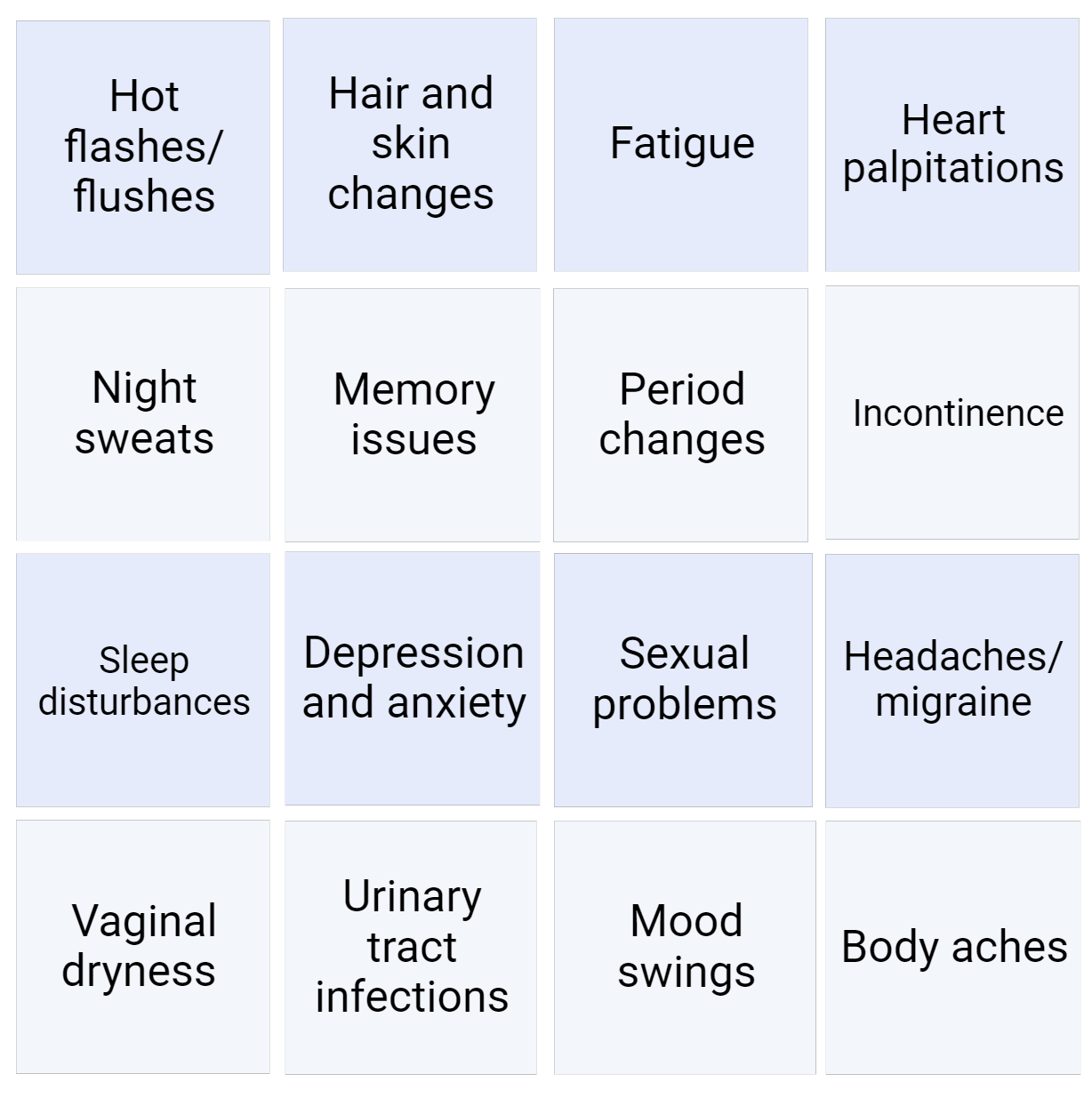
First, the report dives into menopause symptoms that can occur with all types of menopause. You might be surprised to learn that there are more than 30 symptoms of menopause (Figure 2), and while 84% of women were aware of hot flashes and 77% about night sweats, the majority did not know that urinary tract infections, heart palpitations, body aches, headaches/migraine, anxiety, depression, memory issues, and pain during sexual intercourse were all potential symptoms of menopause. In the report, women reported experiencing an average of seven symptoms. Unfortunately, one-third of women felt that their symptoms were undertreated, despite the availability of effective treatments. 


Figure 2. Common Symptoms of Menopause Created using BioRender. Check out the
The Silence and the Stigma report also highlights the challenges women face within the medical system, in their intimate relationships, and in the workplace during menopause. More than half of respondents felt that menopause is “taboo”, and a similar proportion felt unprepared for their menopause journey, leading to feelings of isolation and loneliness. Unfortunately, only 40% of women sought treatment for their symptoms and 72% of those who did found that the medical advice was not helpful or only somewhat helpful. These experiences also impact women’s quality of life and relationships, with 41% of women reporting that menopause negatively impacted their relationship with their significant other. It also affects women’s experiences in the workplace, with three-quarters reporting that their employer was not supportive or did not know if they offered support in helping them to cope with symptoms. 

As Dr. Wendy Wolfman, MD, FRCS(C), FACOG, NCMP noted in the report, “Menopause is seen as something women must endure, like a woman’s burden. This is unacceptable.” In the next part of this series, we will go through the history of menopause hormone therapy and current research in this field. Our third blog will go more into detail about options for menopause treatments, including hormonal, non-hormonal, and lifestyle options. Stay tuned for these blogs and connect with us on social media to share your experiences of menopause, questions about treatment, or share feedback on this series! 

Spot the Difference: Menopause or Endometrial Cancer?

Author: Malak Ibrahim, MSc Student in the Department of Obstetrics and Gynecology, University of British Columbia | Editors: Romina Garcia de leon, Shayda Swann (Blog Coordinators) 

Published: July 21, 2023

All women* and individuals with a uterus will inevitably experience menopause during their lifetime; however, the stigma around menstruation, aging, and women’s health makes it difficult to have open conversations about menopause. Almost half of women in Canada feel unprepared for perimenopause and menopause, and 54% believe the topic is still taboo.

“Menopause is seen as something women must endure, like a woman’s burden.” 

– Dr. Wendy Wolfman, MD, FRCS(C), FACOG, NCMP, President of the Menopause Society of Canada

Menopause is defined as the time period after a woman has gone 12 consecutive months without menstruating. The time period leading up to menopause when women experience a range of symptoms is called perimenopause. During perimenopause, women may experience changes in their menstruation, hot flashes, sleep disruptions, cold sweats, depression, and many more symptoms. There are more than 30 symptoms that can occur as a result of hormonal changes during perimenopause, and although many women are aware of a few common symptoms such as hot flashes and night sweats, awareness of other symptoms such as depression and anxiety remain low. 

So how does this relate to endometrial cancer? Endometrial cancer occurs in the inner lining of the uterus, called the endometrium. It is the most common type of uterine cancer and the most commonly diagnosed gynecologic cancer in the developed world. Unlike most cancers, the number of new endometrial cancer cases continues to rise each year. Endometrial cancer incidence increases by almost 2% each year in women under 50 years old, and 1% in women over 50 years of age. For most patients diagnosed with endometrial cancer, abnormal uterine bleeding is the first noticeable symptom. Abnormal uterine bleeding is defined as any bleeding or spotting during menopause, or any unpredictable pre-menopausal vaginal bleeding such as changes in regularity, frequency, volume, or duration. Even though abnormal uterine bleeding can prompt earlier detection of endometrial cancer, it is not specific to endometrial cancer and can indicate a number of gynecologic conditions. Up to 30% of women will experience abnormal uterine bleeding in their life, and it is especially common during perimenopause. Almost half of women experiencing abnormal uterine bleeding will delay or not seek medical care, resulting in a delayed diagnosis or leaving the underlying cause undiagnosed

Because changes in menstruation are very common and normal during perimenopause, it can be difficult to differentiate between what is regular reproductive aging and early signs of endometrial cancer. So how can you tell the difference between perimenopausal changes in menstruation, and abnormal uterine bleeding that may indicate endometrial cancer? Unfortunately, there is no way to determine if changes in menstruation are associated with perimenopause or more serious pathologies without an endometrial biopsy. However, by raising awareness of both endometrial cancer and menopause, women can be empowered to better understand their health and identify which symptoms of concern need medical attention based on their personal risk of developing cancer. Some risk factors for uterine cancer are obesity, age, diabetes, estrogen only hormone replacement therapy, and genetic predisposition. Open conversation about menstruation and menopause with family, friends, and most importantly, healthcare providers is needed. Women who have an increased risk of uterine cancer should be especially aware of abnormal uterine bleeding and engage in conversation with their health care providers as soon as possible if they experience any unusual uterine bleeding. 

To learn more about symptoms and risk factors of uterine cancer, visit UBC’s own Uterine Health Research Lab website and follow us on social media! 

The Uterine Health Research Lab is currently conducting the RESToRE Study to assess the feasibility and acceptability of early cancer screening and prevention methods. We are recruiting postmenopausal people with a uterus to fill out a risk questionnaire – those who are found to have increased risk factors will be invited to continue in further aspects of the study. For more information or to participate in the RESToRE Study, please click here. 

Facebook: Uterine Health Research Lab

Instagram: @uterinehealth

Twitter: @uterinehealth 

Website: uterinehealth.ca

Behind the Science: Clearing the Fog of Midlife Ovarian Removal and Cognition

Interviewee: Alana Brown, Ph.D. Candidate, University of Toronto, Authors/Editors: Romina Garcia de leon, Shayda Swann (Blog Co-coordinators).

Published: July 14th, 2023

Could you tell us about your research?

In Dr. Gillian Einstein’s Lab of Cognitive Neuroscience, Gender, and Health, my PhD work explores the relationships between ovarian hormones (e.g., 17β-estradiol) and cognition, specifically in women with breast cancer gene mutations who opt to have bilateral salpingo-oophorectomy, which is the removal of both ovaries and fallopian tubes. This surgery usually occurs for cancer prevention purposes around 10 years prior to the typical age of spontaneous/natural menopause (~51 years). Bilateral salpingo-oophorectomy results in an abrupt and early loss of ovarian hormones. Our group in Dr. Einstein’s lab is trying to understand the cognitive impact of this hormone loss, especially given that oophorectomy is associated with an increased risk of developing Alzheimer’s disease (AD) in later life.

What drove you to study women’s health research? 

There is a dearth of research examining factors contributing to cognition among middle-aged women. The spontaneous menopause transition is a time period often defined by self-reported brain fog. So, women are specifying that their memory is changing during this period. Not only is there a gap in research to try to understand this change, but this is also a unique opportunity to answer more nuanced questions about memory in a healthy population. This research gap is even wider for women with bilateral salpingo-oophorectomy.

It is really interesting that we can ask richer questions about memory by looking at an ovarian hormone shift that affects a large number of people in the world. For example, how can the memory changes associated with ovarian hormone loss be differentiated from the memory changes associated with aging? How can we use ovarian hormone-related structural and functional brain changes to answer questions about how the brain supports memory more broadly? In the realm of neuroimaging, menopause and sex-specific factors are conflated with aging and largely overlooked and disregarded. It is very common to see neuroimaging research focusing on aging by studying groups of young adults who are 35 or younger and comparing them to groups of older adults who are 65 or older. The large gap between those age groups, representing midlife, during which menopause is typically occurring, is often ignored. There is a really small percentage of research looking at female-specific outcomes during that time.

What impact do you hope to see with this work?

I hope that this work can contribute to a larger picture of precision medicine. Given that we are studying a group of women who are at increased risk for AD, there may be implications for AD biomarkers. Female-specific AD risk factors must be studied and clarified. I hope this work can contribute to a larger body of research focused on studying people and the complexities of their lives while integrating that complexity into neuroimaging. Further, I hope we know more about the functional effects of reproductive aging and/or ovarian hormone loss in the future, above and beyond the effects of aging. This is new territory for neuroimaging. Those considering bilateral salpingo-oophorectomy deserve to be fully informed and aware of what they may experience after the surgery.

Have you seen any interesting findings yet in your research? 

We are finding that oophorectomy without 17β-estradiol  replacement therapy is associated with decreased hippocampal activation, specifically while learning/encoding during a face-name pair memory paradigm that is thought to be sensitive to AD progression. The hippocampus is a brain area critical for learning/memory and is also among the first regions affected by AD. We do not see the same pattern in individuals with oophorectomy who are taking 17β-estradiol replacement therapy. It is possible that 17β-estradiol has a role in maintaining function in the hippocampus and potential markers of AD risk could be detected in midlife. 

Where can people find more about your work?

Twitter: @4alanabrown and @EinsteinLabUofT, 

Online: https://einsteinlab.ca

LinkedIn: https://www.linkedin.com/in/alana-brown-23544a111/

Check out this recent publication by Alana and the Einstein Lab on how midlife ovarian removal affects cognition!

Understanding the Lived Experience of Perimenopause, Menopause and Post-Menopause


Author: Bhairavi Warke, PhD Student, Simon Fraser University Editors: Negin Nia and Arrthy Thayaparan (Blog Coordinators)

Published: April 8th, 2022

What is lived experience of Menopause?

Menopause is when one has gone an entire year without a menstrual period. The average age for menopause is 51 years. It is preceded by Perimenopause, when women start noticing physical and psychological changes, and followed by post-menopause. This transition can be challenging for many due to symptoms like hot flashes, night sweats, mood swings, etc. Not only does it affect women’s physical and psychological well-being, but it may significantly affect their personal and social lives. For example, menopause symptoms can cause limitations in family life, relationships, professional activities, and more. Additionally, every woman’s experience can greatly vary in terms of the severity and duration of symptoms. For some, the symptoms of menopause can last over a decade and thus, significantly lower their Quality of Life (QoL). 

The World Health Organization (WHO) defines Quality of Life as, “an individual’s perception of their position in life in the context of the culture and value systems in which they live, and in relation to their goals, expectations, standards and concerns. QoL is a multi-dimensional concept affected in a complex way by the person’s physical health, psychological state, level of independence, social relationships, personal beliefs and their relationship to their environment.”  

Although it is a natural phase of life, most women struggle to find relevant information that may help them navigate the menopause journey. Women often feel a sense of isolation or lack of support in social settings. Now-a-days, women exchange information in smaller close-knit groups or over online menopause forums to seek help and support beyond their doctors. Despite the sheer number of people who experience menopause, it still seems to bear stigma and is not yet a commonplace topic in public discourses. Menopause is seen as a personal and private health condition than a regular aspect of life and women are expected to “just figure it out” themselves as they go through it. In addition, post-menopausal women are more vulnerable to heart disease, osteoporosis, and breast, ovarian, or uterine cancers. Thus, understanding the impact of the menopause transition on women’s day-to-day lives, i.e. the lived experience, is crucial to address some of the challenges they face.

Why is it important?

We know that menopause is influenced by more than the physiological changes associated with it. The socio-cultural understandings of menopause have a significant impact on women’s experience of it. However, we know little about how this affects women’s ability to adapt to the new phase of life. Menopause and aging women’s needs are often ignored or rarely discussed in mainstream healthcare product and service innovations. This makes it a hidden reality that not only impacts women’s preparedness for this journey, but it also influences how they can participate and contribute to society. Moreover, the socio-economic burdens and costs of healthcare for women in menopause can be very high. Studies have shown that education, appropriate guidance and effective management can have real benefits in improving women’s QoL as they go through this transition.

Opportunities in Personal Technology

Personalised self-care technologies are becoming more and more ubiquitous. For example, we are surrounded by a large number of fitness trackers and health apps. These technologies focus on tracking personal data like weight, energy levels, physical activities, time usage, sleep and learning strategies, and are intended for self-improvement and behaviour change. Despite their growing success, the existing landscape of interactive self-tracking tools for menopause care is sparse, often limited to period tracking, coaching and information sharing applications. There are a lack of meaningful interventions that could help women through their menopause journey, beyond just tracking symptoms, and seamlessly integrate it within their lifestyles to improve their quality of life.

Where can we start?

To design better self-care tools that are useful for women experiencing menopause, we need to: a) talk to experts in women’s health, and b) understand the lived experience of menopause from women themselves. 

In the initial stage of this research, we, the researchers at the Pain Studies Lab in SFU, are planning to conduct a participatory workshop to explore the lived experiences of menopause from experts in women’s health and from women who are experiencing perimenopause, menopause or post-menopause. The workshop will be conducted online via video conferencing (like Zoom) and participants will discuss how the different stages of menopause affect the day-to-day realities of someone’s life. The workshop will conclude with a short brainstorming activity to explore ideas of what may help women during this transition and benefit their long-term quality of life.

How can we get in contact with you?

If you are an academic researcher or professional expert working in fields related to women’s health or menopause care, WE NEED YOUR HELP! 

Please contact me at bwarke@sfu.ca if you would like to participate in this 2.5-hr online workshop. Participants will be compensated with $20 for their time and contribution.

(Note: We refer to all individuals experiencing symptoms of menopause as ‘women’ in this article. However, we acknowledge all individuals who may or may not identify as ‘women,’ but experience menopause or like symptoms, as a part of this research.)